German company sleeves · Tempo, Berlin and Babelsberg
Tempo: a red catalogue sleeve and a blue factory sleeve
Two sleeves of the German budget label Tempo: one printed with a numbered list of records, the other with a drawing of the Tempo works at Babelsberg.
Dating at a glance
- Printed
- Red: c. 1940 – 1941
Blue: 1938 – 1945 - In use
- Late 1930s and wartime
- Confidence
- Medium for both. The blue sleeve’s range rests on the place name and the firm’s history, not on a dated example
- Basis
- The catalogue numbers on the red sleeve, and the Babelsberg works shown on the blue one
The sleeve
Red catalogue sleeve
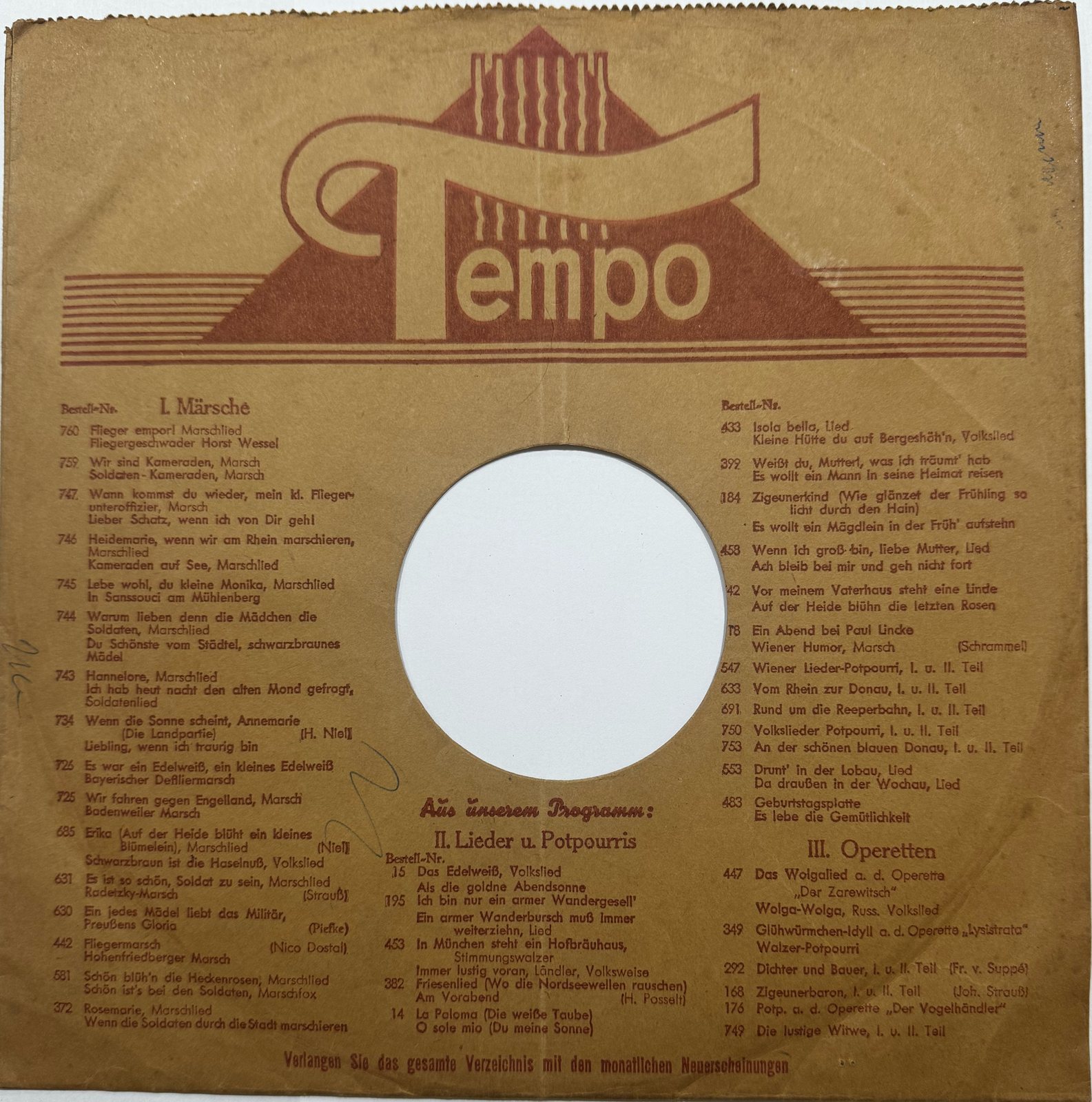
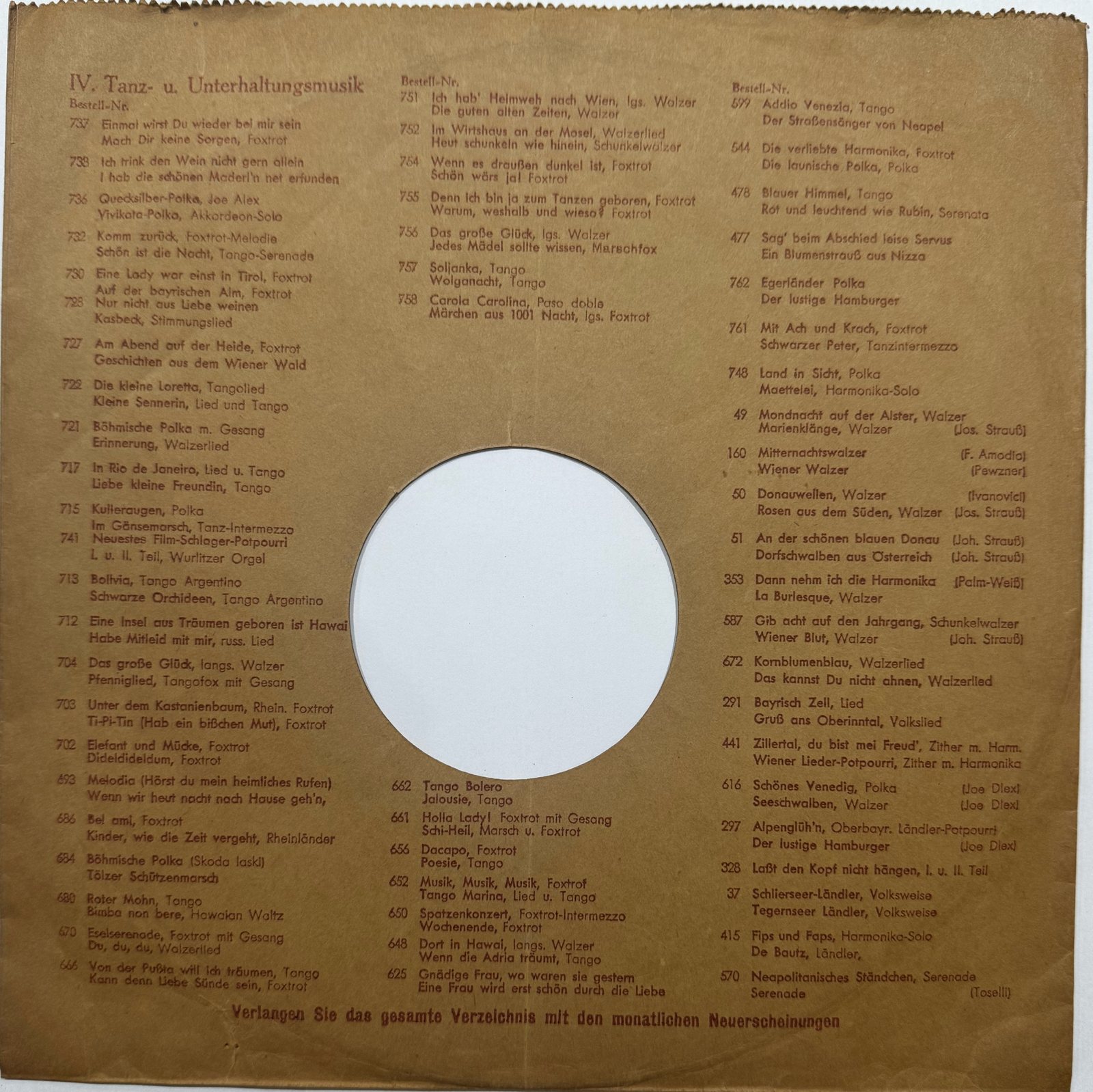
Brown paper printed in red with the Tempo logo and a numbered list of Tempo records in four sections: I. Märsche
, II. Lieder u. Potpourris
and III. Operetten
on one side and IV. Tanz- u. Unterhaltungsmusik
on the other. The highest number on it is 762. The marches section is mostly military marches and soldiers’ songs, including 725 Wir fahren gegen Engelland
. The foot reads Verlangen Sie das gesamte Verzeichnis mit den monatlichen Neuerscheinungen
(“Ask for the complete list with the monthly new releases”). The centre hole is cut off-centre.
Blue factory sleeve
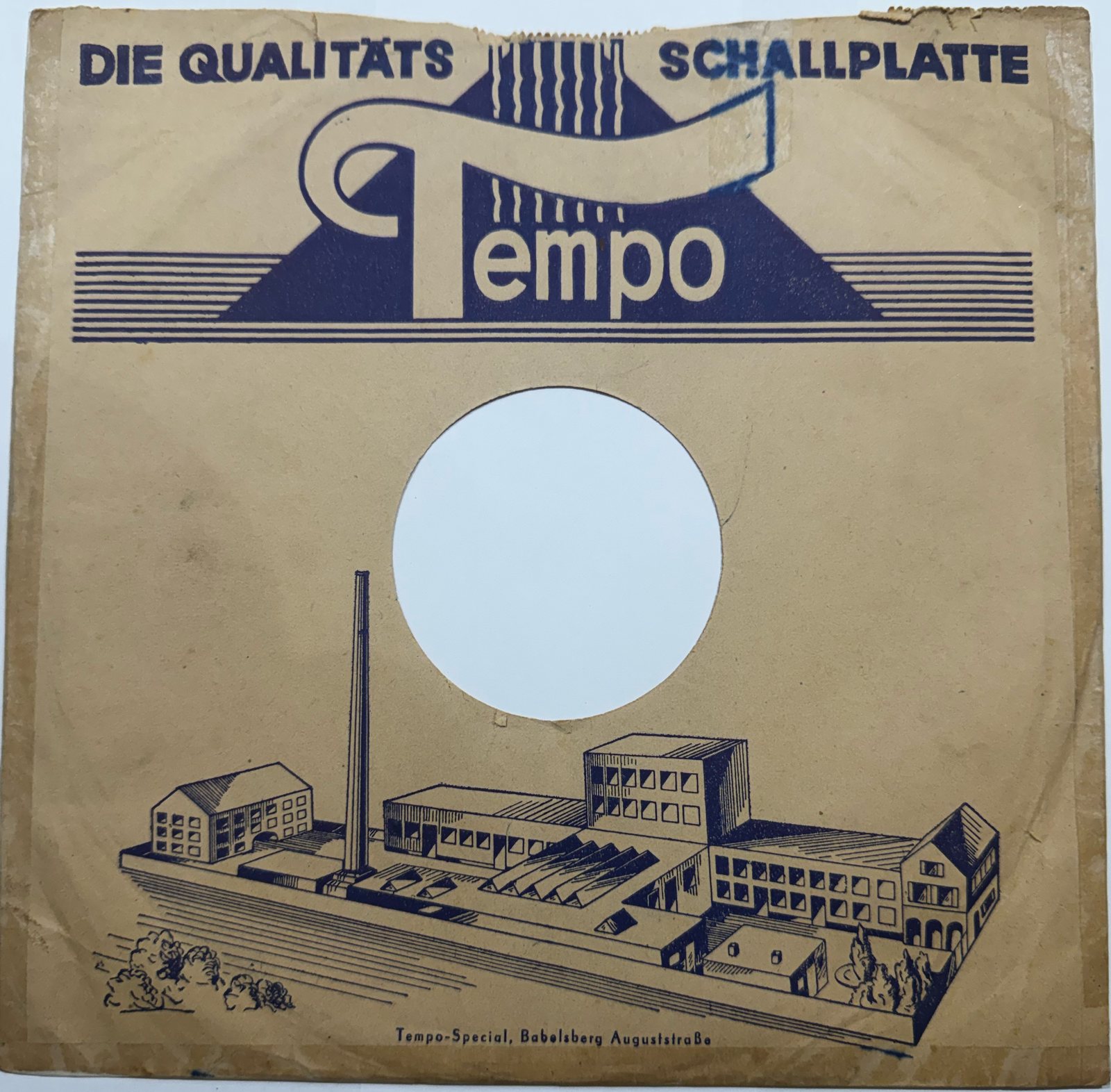
Brown paper printed in blue: DIE QUALITÄTS SCHALLPLATTE
and the Tempo logo above, and below a drawing of a factory captioned Tempo-Special, Babelsberg Auguststraße
. Simon reports that both sides are the same.
The evidence
- DocumentedThe label. Otto Stahmann founded his Brillant record company in Berlin in 1931. In mid-1937 it was renamed Tempo Schallplatten GmbH and the label became Tempo (Reinhard Otto, IASA paper of 2003).
- DocumentedThe numbers. The same paper says the red-brown label series ran up to no. 799 by 1941, and the 5000 series began in 1940.
- InferredSo the red sleeve is from about 1940–41. It lists numbers up to 762 and nothing from the 5000 series. Its wartime marches and soldiers’ songs fit 1939–40.
- DocumentedBabelsberg. From 1938 Tempo pressed records at Auguststraße 45 in Nowawes (Lale-Andersen-Archiv; PotsdamWiki). Nowawes was renamed Babelsberg on 1 April 1938 and joined to Potsdam on 1 April 1939 (City of Potsdam). Tempo used the works until 1945.
- DocumentedAfter the war. Stahmann moved to Munich, and from 1946 the Babelsberg works was run by Lied der Zeit, later the state record company of East Germany (IASA paper; Lale-Andersen-Archiv).
- InferredSo the blue sleeve was very probably printed between 1938 and 1945. It shows the Tempo name and the Babelsberg works, which fits only Stahmann’s time there. Leftover sleeves may have been used after the war; we cannot rule that out.
- ObservedThe order of designs. Phonopassion, a German dealer, lists Tempo sleeve types in sequence: a red catalogue sleeve (Tempo_5), red and then blue factory sleeves (Tempo_7, Tempo_8) and a post-war design (Tempo_11). Simon’s blue sleeve matches Tempo_8. Phonopassion gives no dates.
Sources
- Reinhard Otto, “Die frühere Schallplattenproduktion in Babelsberg und Nowawes”, IASA 2003 (PDF, German): https://iasa-online.de/files/2003_Babelsberg.pdf
- Lale-Andersen-Archiv, Tempo (German): https://lale-andersen.de/lexikon/produktion/tempo-deutsches-reich/
- PotsdamWiki, Tempo Schallplattenwerk (German): https://www.potsdam-wiki.de/Tempo_Schallplattenwerk
- City of Potsdam, territorial changes since 1816 (PDF, German): https://www.potsdam.de/system/files/documents/Potsdam_Gebietsveraendg_histor.pdf
- Phonopassion sleeve type Tempo_5 (image): https://phonopassion.de/images/cover/tempo_5.jpg
- Phonopassion sleeve type Tempo_8 (image): https://phonopassion.de/images/cover/tempo_8.jpg
- Phonopassion original sleeve list: https://phonopassion.de/index.php?key=coveroriginal_de


What we could not find
- Release dates for Tempo 760–762, which would fix the red sleeve more closely.
- A blue factory sleeve found with a dated record.
- Which sleeves Lied der Zeit used for its first post-war pressings.
Researched 12 November 2026 from Simon’s photographs of that evening.