French company sleeve · Société Phonographique Française Polydor S.A.
Polydor: “Le disque de l’élite”
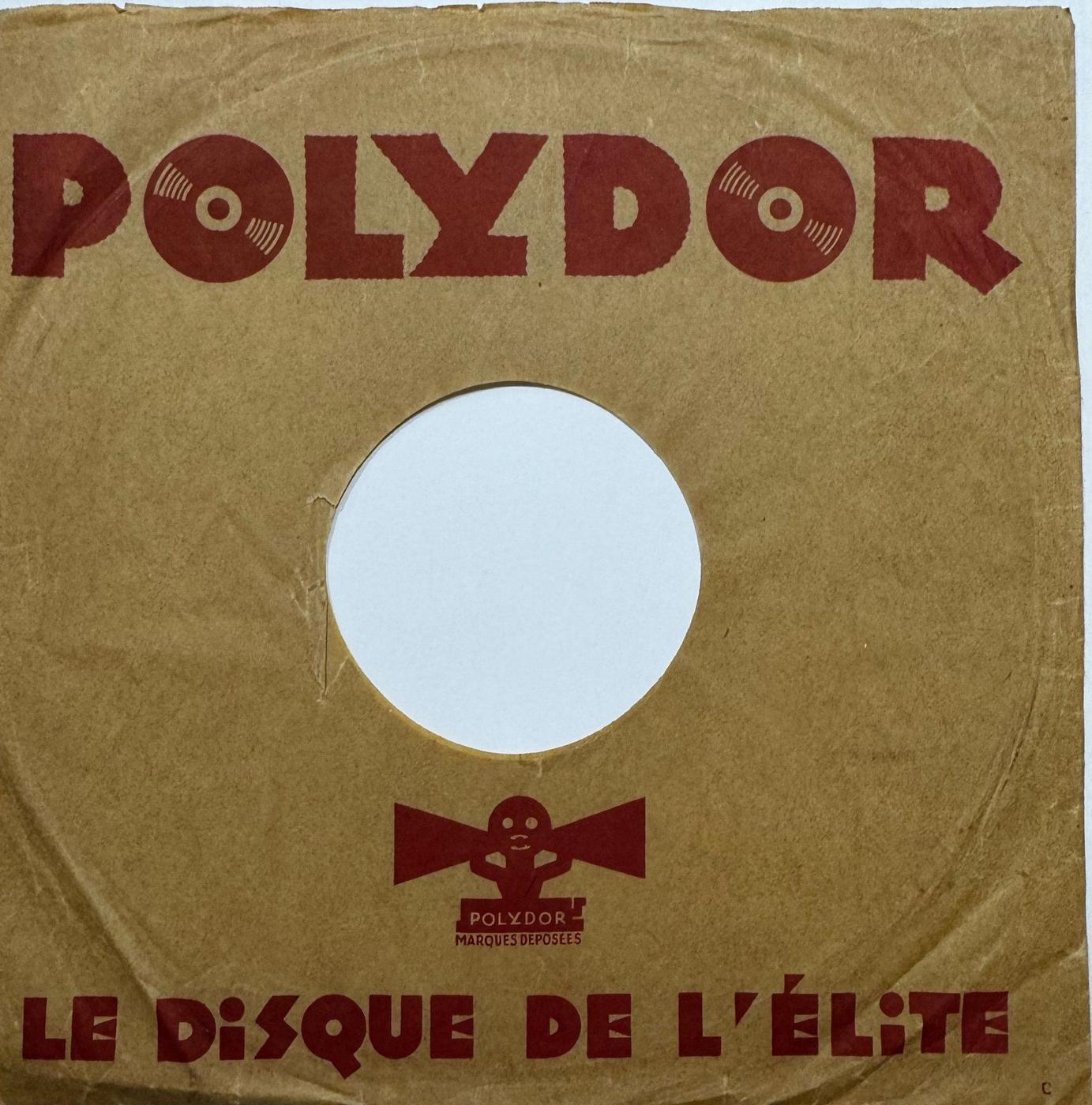
A kraft-paper French Polydor company sleeve, printed in red, with record-shaped Os in the wordmark and the twin-megaphone trademark.
Dating at a glance
- Printed
- By 1941
the design ran on to at least 1950 - In use
- Wartime, and after the war into the early 1950s
- Confidence
- Medium for the design being in use during the war. We cannot date Simon’s copy within the design’s run
- Basis
- Photographs of the same design with dated records, and the wartime NP mark on the 1941 example
The sleeve
Brown kraft paper printed in red. Across the top is POLYDOR
in a heavy sans-serif, the two Os drawn as grooved records. Below the centre hole is the Polydor twin-megaphone trademark: a small figure holding a horn to each side, standing on a block lettered POLYDOR / MARQUES DEPOSEES
. Along the bottom is the slogan LE DISQUE DE L’ÉLITE
. A small printed C
sits at the lower right; it is also present on other copies of this design, so it is a printer’s mark, though we have not identified the printer.
Simon took two photographs of the printed face. The tears, creases and worn corners match in both, so they show the same side of the same sleeve. The second photograph, used here, shows the printed C
more clearly. Only the printed face was photographed; we have not seen the back.
The evidence
- DocumentedA French company, from 1927. Société Phonographique Française Polydor S.A. was set up in Paris in 1927 by the Danish and Swedish subsidiaries of the German firm Polyphonwerke, and was formally established in 1929, with a Paris pressing plant and, from 1933, its head office at 6–8 rue Jenner. From 1934 all its records were pressed in Paris. It was not a late-1930s breakaway from Deutsche Grammophon; it had been a separate French company from the start. In 1951 it was renamed Société Phonographique Philips.
- DocumentedThe firm kept going through the war, with interruptions. After war was declared, German-owned assets in France were sequestered and Polydor’s Paris studio closed in 1939; recording resumed under French direction from November 1939 to May 1940, then again from March 1941 after the Occupation. After the Liberation the firm was sequestered once more and did not resume until March 1945. Discogs records that the letters
NP
on French Polydor labels stand for Nouvelle Pâte and mark a wartime pressing (1940–1945) that used recycled materials. - DocumentedThe twin-megaphone trademark. The little figure with a horn to each side is the Polydor trade mark used on French labels by 1932 (for example Paul Godwin, Polydor 24.446, on Discogs, also illustrated as “France 1932” by Around and Around). The same mark is on the yellow wartime label in the 1941 sleeve photograph cited below.
- ObservedSeen in May 1941, or thereabouts. Encyclopédisque photographs this exact design — including the printed
C
at the lower right — holding Maryvonne, Polydor 524.746, De l’Atlantique au Pacifique / La rue de notre amour, which it dates to May 1941. The label showing through the hole carries the NP mark and the twin-megaphone trademark, and the catalogue number is in the 524 series, which Discogs gives as running until 1945. The matrices are 6062/2 and 6066/2 DRPP. Discogs’ matrix timetable for the Paris plant places the 6030–6153 DRPP block in 1942, so the issue may be a little later than May 1941; the NP mark and the 524 number still put the pressing in the war years. - ObservedThe same design was still in use after the war. Encyclopédisque also photographs this layout holding Patachou, Polydor 560.237, La mariée. That site dates the disc to 1944, which cannot be right: the 560 series began in mid-1946, the label uses an ACP matrix (a suffix Discogs dates from 1947), and the notes to the Frémeaux anthology Patachou 1950–1961 give the 78 as Polydor 560.237, May 1950. A close variant, with the extra line
ENREGISTREMENTS ELECTRO-POLYFAR
under the wordmark, is photographed with Jacqueline François, Polydor 560.149, whose label names the 1949 Grand Prix du Disque. - InferredSo, in use by 1941 and still around 1950. Other French Polydor company sleeves were used in the same years, including a typographic
Le disque de l’élite
design and aNouveauté
banner design, so this is not the only pattern. Nothing on Simon’s copy (which matches the 1941 layout, without the Electro-Polyfar line) shows whether it was printed during the war or is a later printing of the same design. We include it because the design was already in use in 1941, but this copy could be post-war.
Sources
- Discogs, Société Phonographique Française Polydor S.A. (company history, matrix series, NP mark): https://www.discogs.com/label/974849-Soci%C3%A9t%C3%A9-Phonographique-Fran%C3%A7aise-Polydor-SA
- Discogs, Paul Godwin, Polydor 24.446, France 1932 (twin-megaphone label): https://www.discogs.com/release/2558602
- Around and Around, Polydor (twin-megaphone labels, including “France 1932”): https://aroundandaroundcom.wordpress.com/polydor/
- Encyclopédisque, Maryvonne, Polydor 524.746 (May 1941) in this design: https://www.encyclopedisque.fr/disque/76730.html
- Encyclopédisque, Patachou, Polydor 560.237, in this design: https://www.encyclopedisque.fr/disque/76743.html
- Frémeaux & Associés, Patachou 1950–1961, noting 560.237 as May 1950: https://www.fremeaux.com/en/1638-patachou-1950-1961-3561302540528-fa5405.html
- Encyclopédisque, Jacqueline François, Polydor 560.149 (Electro-Polyfar variant): https://www.encyclopedisque.fr/disque/76738.html
- Encyclopédisque, French Polydor 78 rpm list: https://www.encyclopedisque.fr/artiste/21850.html
- Our French company sleeves notes: french-company-sleeves.html
What we could not find
- A first or last official printing date for this exact design.
- The printer behind the letter C.
- The back of Simon’s copy.
- Whether Encyclopédisque’s May 1941 date or the Discogs 1942 matrix block is right for 524.746.
- Any printing detail that reliably separates wartime and post-war copies of the design without the Electro-Polyfar line.
Researched 13 November 2026 from Simon’s photographs.